
BREAKING GROUND™ The Journey to Organizational Validation Theory™ THE POSTMODERN ORGANIZATION
When the Rules, Roles, Relationships, and Realities Change
The Organization Has Changed. Have Our Organizational Theories Changed With It?
A policy may be working exactly as designed.
An employee may still experience it as ineffective.
A communication may be clear when it leaves leadership.
It may create confusion when it arrives.
A performance system may look successful on paper while producing frustration in practice.
Which reality should leaders trust?
That question sits at the heart of the postmodern organization. For decades, organizations were largely understood through structure, hierarchy, authority, defined roles, standardized procedures, and systems of control. These elements remain important. Organizations still need accountability, policies, procedures, and clearly defined responsibilities.
But they no longer tell the whole story.
Today's organizations operate within a rapidly changing environment shaped by technological advances, cultural shifts, economic pressures, generational diversity, changing workforce expectations, and increasingly complex human relationships.
These forces influence much more than productivity and efficiency. They affect how leadership is experienced, how people understand their roles, how knowledge is valued, and how organizational decisions are interpreted.
As a result, organizations have become more complex than many traditional models assume.
The question is no longer simply:
How is the organization structured?
The deeper question is:
What realities are shaping the organization, how are those realities influencing its people, and what conditions are leaders creating in response?
That question is central to a developing body of work known as Organizational Validation Theory™.
At its core is a simple proposition:
Before leaders judge outcomes, they should examine the conditions influencing those outcomes.
To understand that proposition, we first need to understand the postmodern organization.
THE IDEA WAS IN THE DISSERTATION
The origins of this inquiry can be traced to my doctoral research. My original study examined workforce development within the broader context of leadership, organizations, and postmodern thought. The research explored whether traditional workforce theories adequately reflected changing organizational and social realities. The findings revealed gaps in long-held assumptions concerning job classification, seniority, skill replacement, knowledge diffusion, assimilation, upward mobility, and workforce development.
The study also revealed something deeper. Workforce development did not occur independently of the environment in which people worked. Leadership practices, organizational systems, social realities, and institutional structures all appeared to influence opportunities for development, growth, participation, and advancement.
The findings suggested that organizational environments can either support or hinder human and talent development.
Looking back, one conclusion now stands out more clearly than ever:
The development of people cannot be fully understood apart from the organizational and social environments in which that development occurs.
The dissertation established a foundation. This work expands the inquiry.
If organizational realities have changed, what does that mean for leadership, organizational effectiveness, and human development?
THE POSTMODERN ORGANIZATION IS NOT JUST A NEW KIND OF ORGANIZATION
The word postmodern often creates confusion.
It does not simply mean organizations that use advanced technology, support hybrid work, or operate with flatter structures. Nor does it suggest that traditional management practices are obsolete. Instead, postmodern thought provides a lens for understanding organizational complexity when multiple perspectives, experiences, identities, interpretations, and forms of knowledge coexist.
It encourages leaders to ask difficult questions:
Are our assumptions still valid?
Are formal systems producing the outcomes we intend?
Do policies operate in practice the way they operate on paper?
Are different groups experiencing the same organization differently?
The postmodern lens does not reject structure. It challenges leaders to look beyond structure. It asks leaders to examine not only what organizations claim to be doing but what their systems, relationships, and practices are actually producing.
FROM ONE REALITY TO MULTIPLE REALITIES
Organizations often behave as if there is one reality because there is one organizational chart. In practice, there may be many realities operating simultaneously.
The executive may see an effective strategy.
A manager may see competing priorities.
An employee may see inconsistent expectations.
A customer may experience service failures.
A board may see organizational progress.
Frontline workers may see resource shortages.
Which reality is correct?
Perhaps all of them contain part of the truth. This does not mean every perception is equally accurate. It means leaders should resist assuming that the perspective closest to their own position represents the entire organization. Effective leadership begins when leaders recognize the difference between organizational assumptions and organizational experiences.
THE SOCIAL STRUCTURE HAS CHANGED
An organizational chart reveals reporting relationships.
It does not reveal trust.
It does not reveal influence.
It does not reveal communication patterns.
It does not reveal informal networks.
Organizations operate through far more than formal structures. They also operate through relationships, culture, professional networks, group identities, communication practices, and shared experiences. Today's environment adds even more complexity through:
Hybrid work arrangements
Distributed teams
Contractors and consultants
Digital communication platforms
Technology-mediated collaboration
These changes create opportunities. They also create challenges involving communication, coordination, belonging, participation, accountability, and trust.
An organization may appear accessible on paper while employees remain reluctant to speak openly because previous experiences taught them otherwise.
That distinction matters.
The organization that is designed and the organization that people experience are not always the same.
Great leaders learn to understand both.
TECHNOLOGY HAS CHANGED MORE THAN THE WORK
Technology continues to transform communication, decision-making, information sharing, performance measurement, and organizational operations. Artificial intelligence is accelerating that transformation. Yet technological change is not merely a technical challenge. It is also a human challenge.
Consider the questions leaders now face:
How does remote work affect learning and professional development?
How does AI influence accountability and decision-making?
How do digital systems shape participation and access to information?
What happens when people are expected to adapt without sufficient support?
How do we know whether technological efficiency is improving the human experience of work?
Technology can solve one problem while creating another. A system can improve efficiency while reducing clarity. An automated process can improve consistency while raising concerns about transparency. The question is not whether organizations should use technology.
The question is whether leaders understand the human implications of the technologies they deploy.
COMPLEXITY IS SOCIAL, NOT JUST TECHNOLOGICAL
Much of today's organizational complexity reflects changes in people, not simply changes in technology. People enter organizations with different experiences, values, expectations, communication styles, cultural backgrounds, and professional identities. Those differences can become sources of creativity, learning, innovation, and growth.
They can also become sources of misunderstanding, fragmentation, and conflict.
Leadership is not about eliminating differences. It is about creating conditions under which differences can be understood, respected, and managed constructively. This insight emerged repeatedly in my original research. What appears to be an individual problem may sometimes reflect a broader organizational issue.
Disengagement may not always be an attitude problem.
Resistance may not always be a commitment problem.
Communication failures may not always be communication problems.
Sometimes they are indicators of deeper organizational dynamics that warrant examination.
THE LEADER AS ORGANIZATIONAL ARCHITECT
This brings us to leadership. Leadership is not simply the exercise of authority.
It is the shaping of environments. Leaders influence:
What receives attention
What gets rewarded
What gets funded
What is tolerated
What is developed
What is changed
Through these decisions, leaders help shape the environment in which people work, learn, collaborate, and perform. For this reason, I believe leaders should be viewed as:
Architects of organizational conditions, not merely managers of organizational outcomes.
The architect's responsibility extends beyond measuring performance.
It includes understanding the factors that help produce that performance.
Leadership therefore requires ongoing examination of:
Structure
Culture
Relationships
Learning
Resources
Communication
Leadership practices
The goal is not blame. The goal is understanding.
THIS IS WHERE ORGANIZATIONAL VALIDATION BECOMES IMPORTANT
The more complex organizational life becomes, the more important examination becomes.
Organizational Validation Theory™ does not suggest that every employee perception is correct.
It does not remove accountability.
It does not eliminate standards.
Instead, it begins with a simple but powerful question:
Has the organization adequately examined the people, systems, relationships, experiences, and conditions influencing its outcomes?
Before judging performance, examine the environment.
Before diagnosing resistance, examine the implementation.
Before assigning blame, examine the evidence.
Before prescribing solutions, examine the problem.
Organizational validation asks leaders to consider not only what happened, but also what may have contributed to what happened.
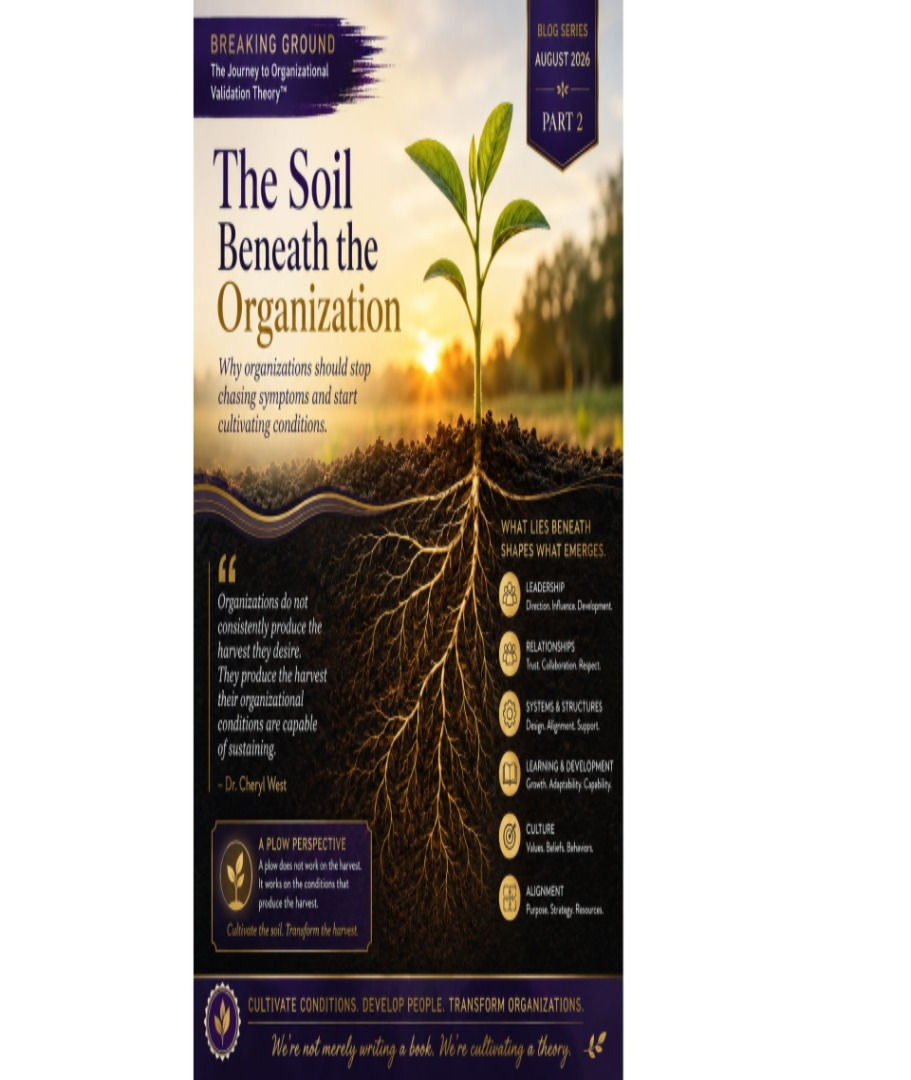
THE PLOW RETURNS
The metaphor of the plow provides a useful way of understanding this work.
A plow does not begin with the harvest.
It begins with the soil.
It breaks through hardened surfaces.
It exposes what lies beneath.
It prepares the ground for cultivation.
Organizations often respond to recurring problems through new policies, additional training, restructuring, or personnel changes. Sometimes those interventions are necessary. But if underlying conditions remain unchanged, many of the same problems eventually return. The plow suggests a different sequence:
Observe the outcome.
Examine the context.
Question assumptions.
Investigate underlying conditions.
Determine what must be preserved, corrected, or changed.
Then cultivate conditions that support better outcomes.
The harvest reveals what happened.
The soil helps explain why.
TWO QUESTIONS FOR LEADERS
Question 1
When organizational structures change, what happens to the relationships, identities, power dynamics, and human needs embedded within those structures, and how are you responding as a leader?
Question 2
Are you asking people to adapt to your organization without first examining whether your organization's systems, leadership practices, communication methods, and culture have adapted to the realities of the people you employ and serve?
These questions challenge leaders to examine not only employee behavior but also the environments in which that behavior occurs.
THE ORGANIZATION HAS CHANGED. WHAT WILL LEADERS DO?
The answer is not to abandon structure.
It is not to reject leadership.
It is not to eliminate accountability.
The answer begins with examination.
Examine the assumptions beneath the systems.
Examine the gap between policy and experience.
Examine the relationship between people, leadership, culture, and performance.
Examine whether the environment being created is capable of producing the outcomes being pursued.
The dissertation identified changing realities.
Organizational Validation Theory™ seeks to explore their implications.
The PLOW Framework™ seeks to help leaders apply those insights in practice.
The organization has changed.
The social realities have changed.
The complexity has changed.
The question is whether leaders are willing to look beneath the surface.
Because the harvest tells us what happened.
The soil helps us understand why.
Dr. Cheryl West
NEXT IN THE BREAKING GROUND™ SERIES
FROM THEORY TO PRACTICE: THE PLOW FRAMEWORK™
Understanding organizational conditions is the beginning. The next challenge is learning how leaders can intentionally examine, cultivate, and improve those conditions.
We are not merely writing a book. We are cultivating a theory.


Comments