
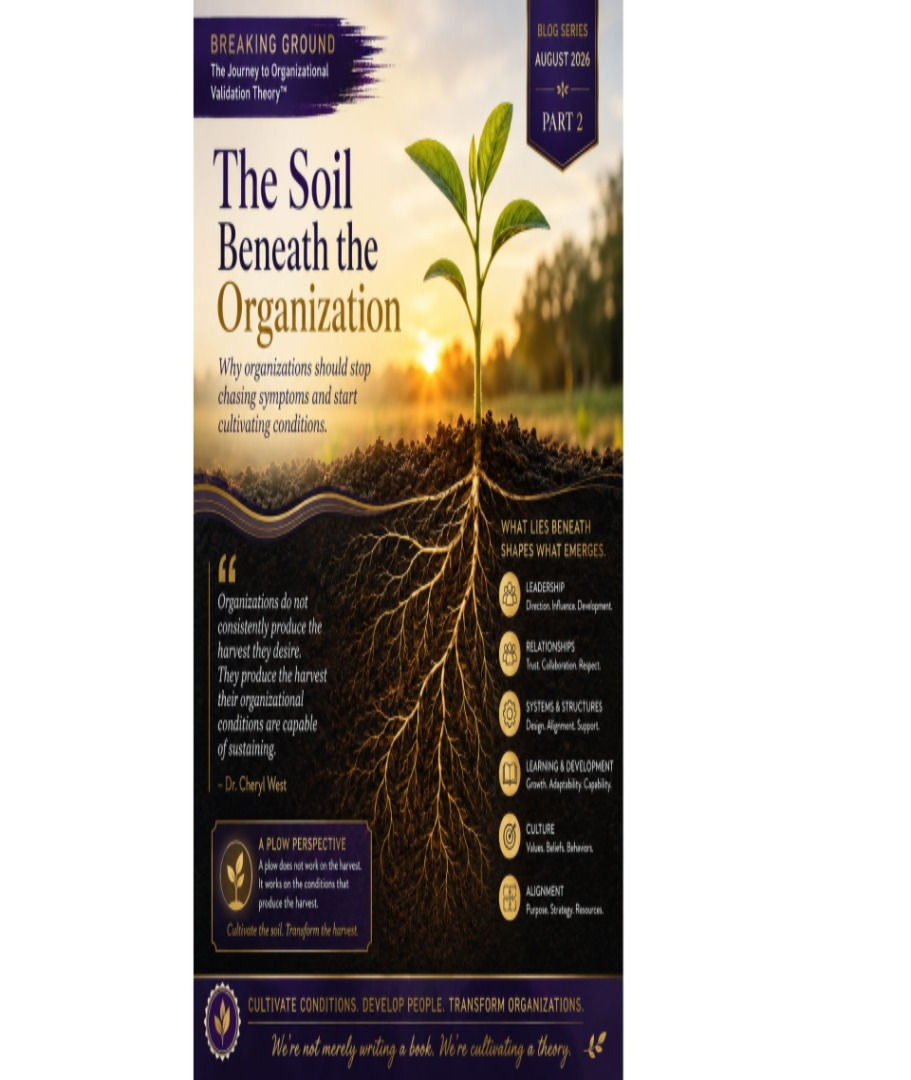
BREAKING GROUND - The Journey to Organizational Validation Theory™
The Hidden Architecture of Healthy Organizations
What is beneath the surface may determine what appears above it.
We often recognize an organization by what we can see. Its structure. Its policies. Its leadership. Its strategic plan. Its programs. Its performance measures. Its employees.
But organizations also have an architecture that is not immediately visible.
It exists in the relationships, assumptions, communication patterns, leadership practices, systems, expectations, culture, resources, and social realities that shape how people experience the organization and how the organization functions.
This is the architecture beneath the surface.
And sometimes, what appears to be an employee problem may be organizational conditions.
LOOK BENEATH THE SURFACE
My original research into leadership, organizations, and workforce development revealed something that has become increasingly important as I revisit the study. The findings did not point only to individual workers and their skills. They revealed a complex interaction among workforce, leadership, organization, and changing social realities.
Among the identified workforce-development impediments were lack of leadership vision, organizational structures that did not support mission or vision, inadequate development resources, mixed messages, staff instability, heavy workloads, organizational politics, ineffective leadership, and lack of leader investment.
The study also identified conditions that could support workforce development—including leadership involvement, organizational knowledge, development opportunities, mentoring and coaching, flexible work arrangements, resources, assessment, accountability, and continuous development.
These findings suggest an important question:
What happens when an organization attempts to develop people without examining the environment in which that development must occur?
THE ORGANIZATION IS MORE THAN ITS ORGANIZATIONAL CHART
An organizational chart can show us:
Who reports to whom?
It cannot necessarily show us:
Who trusts whom?
It can show positions and authority.
It cannot fully reveal:
communication patterns
informal relationships
organizational assumptions
competing priorities
employee perceptions
leadership messages
cultural expectations
resistance to change
knowledge-sharing practices
opportunities for development
Yet these less visible elements can influence how an organization operates.
The architecture is there. We simply must know how to look for it.
THE HIDDEN ARCHITECTURE
I think about organizational conditions through several interconnected dimensions:
LEADERSHIP
How leaders communicate, develop people, establish expectations, allocate resources, and respond to organizational realities.
STRUCTURE
Whether organizational systems, roles, policies, and processes support the mission and the people responsible for carrying it out.
RELATIONSHIPS
How people communicate, collaborate, share knowledge, resolve differences, and build trust.
CULTURE
What the organization consistently values, reinforces, rewards, tolerates, and communicates—both formally and informally.
LEARNING
Whether development is treated as an occasional event or as an ongoing organizational process.
RESOURCES
Whether people have the time, funding, tools, opportunities, and support necessary to develop and perform.
These dimensions should not yet be viewed as a finalized model of Organizational Validation Theory™. They are emerging areas of inquiry that are being examined against the original research.
THE QUESTION CHANGES
Traditional organizational problem-solving often begins with:
"What is wrong?"
Organizational Development may ask:
"What intervention is needed?"
Organizational Validation Theory™ invites another question:
"What conditions are producing the reality we are experiencing?"
That question takes us deeper.
If morale is low, examine the conditions.
If turnover is high, examine the conditions.
If communication is breaking down, examine the conditions.
If employees resist change, examine the conditions.
If development programs are not producing sustained change, examine the conditions.
This does not mean that individuals are never responsible for organizational problems.
It means that individual behavior should be examined within the organizational environment in which that behavior occurs.
FROM SYMPTOM TO SYSTEM
Consider a simple example.
An organization says:
"Our employees aren't engaged."
That statement describes an outcome.
But it does not explain the condition.
We might ask:
What are employees experiencing?
Are expectations clear?
Are leaders communicating consistently?
Are people given meaningful opportunities to contribute?
Is development available?
Are workloads reasonable?
Do organizational systems support the behaviors leaders say they want?
Are employees receiving conflicting messages?
The answers may reveal that what initially appeared to be an engagement problem is connected to several organizational conditions.
That is the deeper work.
THE HR/OD PRACTITIONER AS ARCHITECT
This raises an interesting possibility for Human Resource or Organization Development practitioners.
Perhaps the HR/OD practitioner is not simply an organizational "analytical person."
Perhaps the practitioner is also an organizational architect.
An architect studies:
foundations
structures
connections
load
function
design
environment
before recommending changes.
Likewise, organizational development requires attention to what exists beneath visible organizational outcomes.
Before changing the organization, understand its architecture.
TWO QUESTIONS FOR HR & OD PRACTITIONERS
1. When an organization presents you with a problem, how often do you examine the conditions producing the problem before recommending an intervention?
2. What organizational realities might remain invisible if your assessment focuses primarily on structures, processes, and measurable outcomes?
These questions are not intended to provide easy answers.
They are intended to change what we look for.
THE DISCOVERY CONTINUES
As I revisit my original dissertation, I am finding that some of the most significant insights were not necessarily the most obvious ones.
The research identified changing social realities, relationships, and constructions as a major finding. It also concluded that organizational "flux" affected workforce development.
That language is particularly interesting today.
Organizations are constantly being shaped by changing technologies, workforce expectations, demographics, social relationships, economic pressures, and organizational priorities.
The organization is not static.
The soil is continually changing.
Therefore, organizational cultivation cannot be a one-time event.
It must be ongoing.
A NEW WAY OF LOOKING
This is where the emerging Organizational Validation Theory™ begins to take shape.
Perhaps organizational effectiveness cannot be fully understood by examining the harvest alone.
Perhaps we must examine:
the soil,
the roots,
the architecture,
the cultivation,
and
the conditions.
Only then can we begin to understand why particular organizational outcomes repeatedly emerge.
THE QUESTION I AM LEAVING WITH YOU
If you could see beneath the surface of your organization today, what would you discover?
Would you find conditions that cultivate:
trust?
learning?
innovation?
collaboration?
human development?
adaptability?
Or would you discover conditions that make those outcomes difficult to sustain?
Don't rush to answer.
Look beneath the surface.
That is where the architecture begins.
NEXT MONTH — OCTOBER 2026
The PLOW Framework™
Why lasting organizational transformation begin beneath the surface.
We move from examining the soil to exploring what it means to cultivate it.
We are not merely writing a book. We are cultivating a theory.
— Dr. Cheryl West



Comments