
BREAKING GROUND™ The Journey to Organizational Validation Theory FROM THEORY TO PRACTICE: The PLOW Framework™
Introducing the PLOW Framework™: Preparing the Ground for Organizational Growth
The harvest does not begin at harvest time. It begins with the condition of the soil.
We Have Examined the Organization. Now What?
In our previous installment, The Postmodern Organization: When the Rules, Roles, Relationships, and Realities Change, we explored how organizations have become increasingly complex. Changes in technology, workforce demographics, communication, relationships, expectations, and organizational structures have challenged traditional ways of thinking about leadership and organizational effectiveness.
We raised an important question:
The organization has changed. Have our organizational theories changed with it?
But recognizing change is only the beginning.
Leaders must also ask: What are we doing about the conditions within our organizations that influence how people think, work, develop, contribute, and perform?
It is one thing to identify organizational challenges. It is another to understand what produces them. And it is something entirely different to intentionally address the conditions that allow those challenges to persist.
This is where we move from theory to practice.
Why Another Framework?
Organizations are not short on leadership models, strategic plans, performance measurements, organizational assessments, or improvement initiatives.
Yet many leaders continue to encounter familiar challenges:
Employees are expected to perform, but the conditions supporting performance are inadequate.
Organizations invest in training, but opportunities to apply new knowledge are limited.
Leaders communicate expectations, but organizational practices send conflicting messages.
Teams are expected to collaborate, but systems and relationships discourage cooperation.
Organizations seek innovation, but policies and practices may reward conformity.
Leaders want engagement and commitment, but employees may not experience the organizational support necessary to contribute meaningfully.
These challenges invite us to look beyond the visible symptoms.
What if the problem is not simply that employees need more training, leaders need another strategy, or organizations need another initiative?
What if we also need to examine the organizational conditions in which people are expected to function and grow?
The PLOW Framework™ is being developed to help leaders do precisely that.
Introducing the PLOW Framework™
The PLOW Framework™ is an emerging application framework associated with Organizational Validation Theory™. It provides a practical way for leaders to examine the conditions beneath organizational outcomes and consider how those conditions can be improved.
The name is intentional.
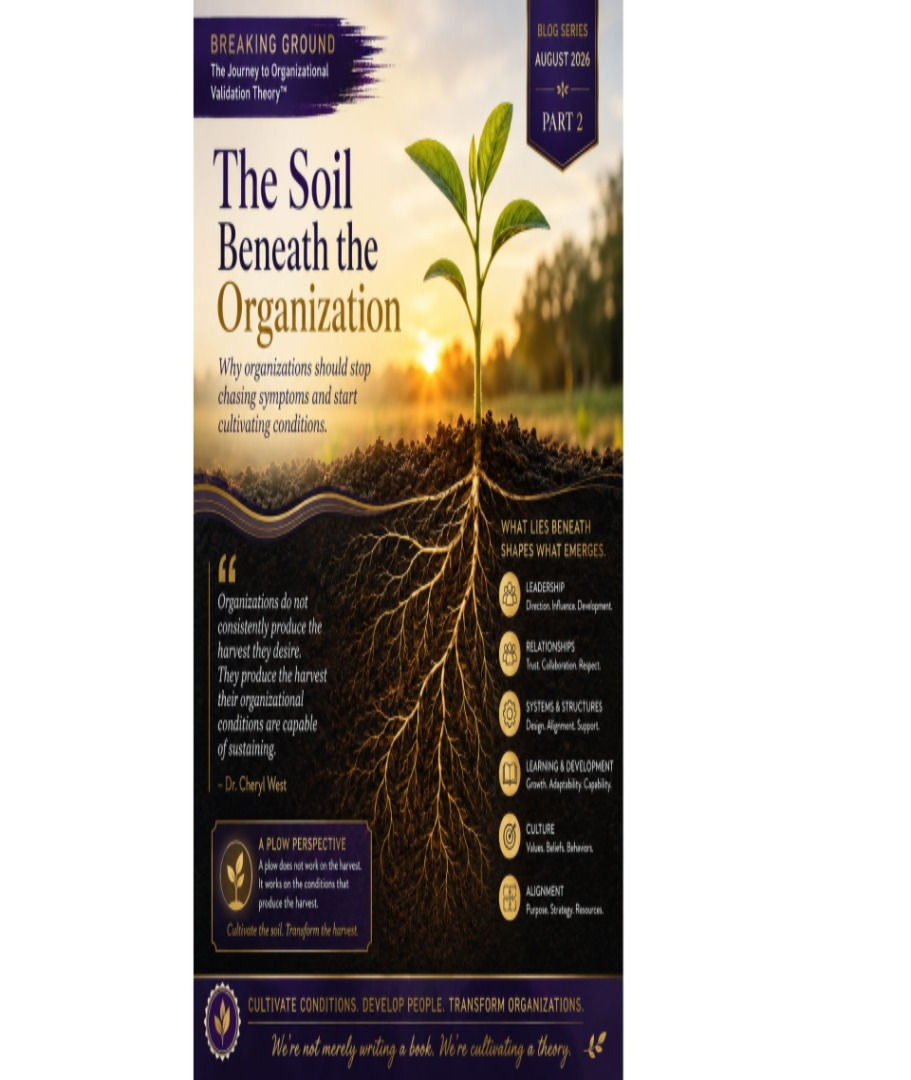
A plow does not work on the harvest. It works on the ground that makes a future harvest possible. In the same way, leaders cannot sustainably improve organizational outcomes by concentrating exclusively on the outcomes themselves. They must also examine the underlying conditions that influence those outcomes.
The PLOW Framework™ shifts the leadership question from:
How do we get better results from our people?
To:
What conditions must we cultivate so people and organizations can produce better results?
This is not a rejection of performance expectations, accountability, organizational standards, or measurable results. Rather, it recognizes that expectations and results must be considered alongside the conditions that support them.
The PLOW Metaphor: Leadership Must Work Beneath the Surface
Consider what happens when a farmer prepares land for planting.
The farmer does not simply scatter seeds and expect a productive harvest. The ground must be examined and prepared. Conditions that interfere with growth must be addressed. Nutrients, resources, and appropriate care must be considered. Cultivation requires attention, intentionality, and ongoing work.
Organizations are not farms, and people are not crops. The metaphor is intended to help us understand something important about organizational leadership: visible results are influenced by conditions that may not be immediately visible.
An organization may have a strategic plan, a talented workforce, financial resources, and clearly stated expectations. Yet these assets do not automatically produce a healthy, effective, or sustainable organization.
Leaders must examine the environment in which these assets are expected to function.
The PLOW metaphor invites leaders to look beneath the surface.
What Must Leaders Examine?
The organizational ground is influenced by multiple, interconnected conditions. These may include:
1. Leadership
Leadership vision, communication, decision-making, ethics, accountability, investment, and the ability to recognize and address barriers.
2. Organizational Structure
Policies, procedures, reporting relationships, decision-making authority, operational systems, and alignment between organizational structures and mission.
3. Relationships
Trust, collaboration, inclusion, communication, respect, conflict, and the ways people interact across organizational levels.
4. Culture
Shared values, beliefs, assumptions, behaviors, expectations, traditions, and the informal practices influence how employees experience the organization.
5. Learning and Development
Access to learning, leadership development, mentoring, coaching, career opportunities, knowledge sharing, and the ability to apply what has been learned.
6. Resources and Support
Time, funding, staffing, technology, tools, organizational support, and the resources necessary to carry out responsibilities effectively.
These areas are not isolated. They interact and influence one another. A weakness in one area may affect the effectiveness of another.
For example, an organization may provide professional development opportunities but have leadership practices that discourage employees from applying new ideas. The training may be adequate, but the surrounding conditions may limit its impact.
The question is not simply whether the organization provides training.
The deeper question is whether the organization cultivates conditions in which learning can translate into development and improved performance.
The PLOW Framework™ and Organizational Validation Theory™
It is important to distinguish the emerging theory from the framework being developed to apply it.
Organizational Validation Theory™ — WHY
The theory seeks to explain why organizational conditions matter and how those conditions influence human development and organizational outcomes.
PLOW Framework™ — HOW
The framework provides leaders with a practical approach for examining, addressing, and cultivating organizational conditions.
Relationships are important.
Theory without application may remain an intellectual exercise. Application without an understanding of underlying conditions may produce temporary improvements without addressing the factors contributing to recurring challenges.
Together, the developing theory and framework offer a way to connect organizational understanding with intentional leadership practice.
Leaders Must Become Condition-Setters
Leadership is often measured by decisions, strategies, goals, and results. These are important responsibilities. However, leaders also influence the conditions in which organizational life takes place. Through their decisions, behaviors, priorities, policies, communication, and allocation of resources, leaders help shape what is encouraged, supported, rewarded, overlooked, or discouraged. This places an important responsibility on organizational leaders.
Leaders cannot control every organizational outcome. They cannot eliminate every challenge or guarantee that every individual will respond in the same way. But they can examine the conditions they influence and take responsibility for improving them.
This requires a shift in perspective.
Instead of asking only whether employees are meeting expectations, leaders must also consider whether organizational conditions support those expectations.
Instead of assuming resistance is simply an employee problem, leaders should examine the organizational experiences and conditions contributing to it.
Instead of responding to declining morale with another motivational initiative, leaders should investigate the experiences, relationships, practices, and systems influencing morale.
Effective leadership requires more than managing the harvest. It requires cultivating the ground.
A PLOW Moment: Questions Every Leader Should Consider
Before introducing another initiative, changing another policy, or implementing another performance improvement strategy, consider these questions:
What organizational conditions are contributing to the results we are currently experiencing?
Are our organizational structures aligned with our mission, vision, and expectations?
Do our leadership practices encourage trust, communication, accountability, and collaboration?
Are employees given meaningful opportunities to learn, develop, and contribute?
Do our policies and procedures support human development, or do they unintentionally create barriers?
Are we addressing underlying conditions, or repeatedly responding to visible symptoms?
What must change in the organizational environment before we can reasonably expect different results?
These questions are not intended to assign blame. They are intended to encourage deeper examination, informed leadership, and intentional organizational improvement.
The Work Ahead: From Examination to Cultivation
The PLOW Framework™ is part of a larger effort to translate the insights of an original research study into a developing organizational theory and a practical approach for leaders. The original dissertation examined workforce development influencers, impediments, challenges, and essential components. It also explored the relationships among leadership, organizations, and workforce development.
The work now continues by examining what those findings may reveal about the broader organizational conditions that influence human development and organizational effectiveness.
This is an important distinction: the developing theory and framework must remain grounded in the original research while allowing room for further examination, refinement, and contemporary application. The goal is not simply to give leaders another set of activities to complete. The goal is to help leaders think differently about the environments they are responsible for shaping.
A Final Thought for Leaders
An organization can invest in its people and still fail to cultivate the conditions necessary for their development. It can establish goals without aligning its systems. It can communicate values without reinforcing them through practice. It can demand accountability without providing adequate support. And it can repeatedly seek a better harvest without examining the soil.
The PLOW Framework™ invites leaders to pause, examine, and work beneath the surface.
Because lasting organizational improvement requires more than changing what people produce. It requires examining the conditions in which people work, learn, develop, and contribute.
The plow does not work on the harvest. It works on the conditions that produce the harvest.
That is where meaningful organizational change begins.
LOOKING AHEAD — PART 6
Organizational Validation Theory™: Understanding the Soil Beneath the Harvest
In our next installment, we will take a closer look at the developing theory itself: its foundational ideas, emerging constructs, and the relationship between organizational conditions, human development, leadership, and organizational outcomes.
We will continue exploring what it means to validate the conditions that support human and organizational growth.
We are not merely writing a book. We are cultivating a theory.
Dr. Cheryl West , Exec. MPA
Organizational Validation Theory™ | PLOW Framework™ BREAKING GROUND™ — The Journey to Organizational Validation Theory


Comments